
Paysafecard Voucher Denominations Available in Australia
 Available in US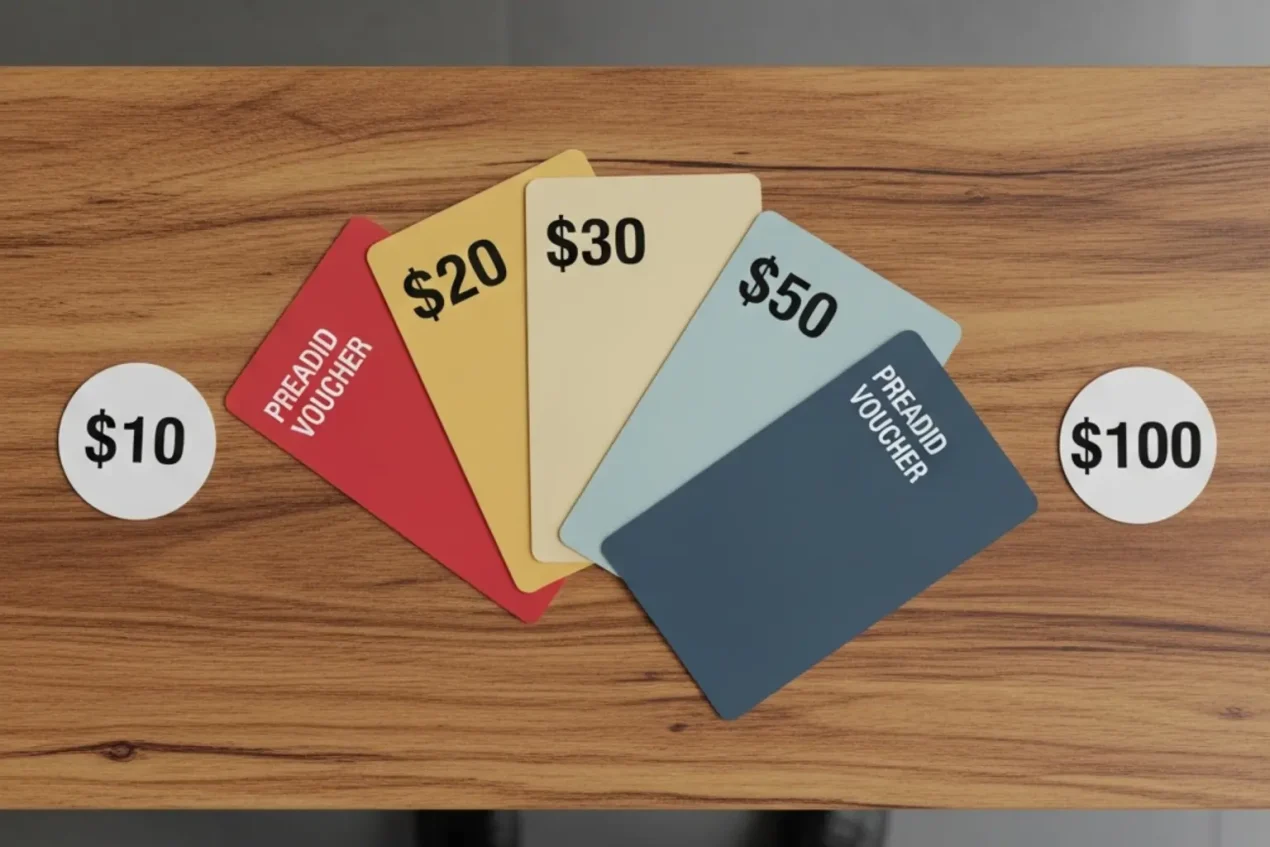
I once watched a punter at a newsagent in Melbourne ask for a $250 Paysafecard and get a blank stare from the cashier. The highest denomination in stock was $100. He ended up buying three separate vouchers and combining them later — a perfectly workable solution, but one he could have avoided if he’d known what was available before walking in. Paysafecard’s retail network covers over 500,000 points of sale globally, yet the denominations on offer in Australia follow their own set of rules that even regular users don’t always know.
This guide lays out exactly which Paysafecard values you can buy in Australia, how those values differ between retail and online channels, and how to combine PINs when a single voucher isn’t enough for your deposit.
The wider context sits in our guide to Paysafecard betting in Australia.
Current Denominations Sold in Australia
Let me cut straight to the numbers, because that’s what you’re here for. Australian retailers typically stock Paysafecard vouchers in a set of standard denominations: $10, $20, $30, $50, and $100. These are the values you’ll find at newsagents, petrol stations, and convenience stores that carry the product.
The $100 voucher is the ceiling in most retail settings. Some sources cite a $200 per-voucher limit for Australia, but in my experience mapping retail availability across Sydney, Melbourne, and Brisbane, $100 is the highest denomination consistently available off the shelf. The $200 figure appears in older references and may reflect either historical pricing or specific authorised resellers rather than the standard retail range.
Lower denominations — $10 and $20 — exist for a reason that goes beyond small purchases. They serve as entry points for new users testing the system, as top-ups for partial balances, and as precise budget tools for punters who want to cap a single betting session at exactly $20 rather than dealing with leftover balance from a larger voucher.
The prepaid card market in Australia has reached $26.01 billion in 2025, growing at 9.9% annually. Within that market, fixed-denomination vouchers like Paysafecard occupy a defined niche alongside open-value prepaid cards and digital wallets. The standard denomination range reflects what retailers can manage in terms of inventory and what customers most frequently request.
Denomination Differences — Retail vs Online Purchases
Something I noticed early in my work with prepaid systems: the online and retail channels don’t always offer the same values, and the differences catch people off-guard.
Retail purchases are constrained by what’s physically stocked. A newsagent carries specific denominations printed on physical voucher cards or generated by their POS terminal. You get what’s available, and if the exact value you want isn’t in stock, you choose the nearest option or buy multiples.
Online purchases through My Paysafecard or authorised digital resellers can offer more flexibility. Depending on the platform, you may be able to purchase custom values within a range rather than being locked to fixed denominations. My Paysafecard accounts also let you load multiple vouchers into a single balance, effectively creating a custom denomination by combining smaller purchases.
The trade-off is clear. Retail gives you cash-payment privacy and immediate physical possession of the PIN. Online gives you denomination flexibility and the convenience of purchasing from home. For betting purposes, the choice often depends on timing — if you need funds now and a retailer is nearby, walk in and buy. If you’re planning deposits for the week ahead, online purchase lets you fine-tune the amount.
In 2024, digital payments accounted for 53% of all e-commerce transactions in Australia, overtaking card payments and cash for the first time. That shift has pushed more Paysafecard purchases into digital channels, but the retail network remains critical for cash-based buyers who specifically want to avoid electronic purchase trails.
Combining Multiple PINs for Larger Deposits
The $100 retail ceiling creates an obvious question: what if you want to deposit more than $100? I’ve tested this extensively, and the PIN-combining feature works reliably — with some caveats worth knowing.
Most bookmakers that accept Paysafecard allow you to enter multiple PINs during a single deposit transaction. The process varies slightly by platform, but the general pattern is: select Paysafecard as your deposit method, enter the first PIN, confirm that amount, then add additional PINs until you reach your desired total. Some platforms present a “add another PIN” button after the first entry; others require separate deposit transactions for each PIN.
My Paysafecard accounts simplify this by letting you load multiple voucher PINs into a single account balance before depositing. Instead of entering three PINs at the bookmaker, you load all three into your My Paysafecard balance first and then make one deposit for the combined amount. It’s cleaner and reduces the chance of a mid-deposit error.
The limits on combining PINs aren’t set by Paysafecard itself but by the receiving platform. Bookmakers impose their own maximum deposit amounts per transaction and per day. If a bookmaker’s maximum Paysafecard deposit is $500, you can combine up to five $100 vouchers in that window. If the cap is $200, two vouchers is your limit per transaction.
One practical note: unused balance on a voucher doesn’t disappear. If you have a $100 voucher and deposit $80, the remaining $20 stays on that PIN for future use. This means you don’t need to match denominations perfectly to your intended deposit — any leftover balance carries forward.
Picking the Right Denomination for Your Betting Budget
Ishan Vaid, VP of Core Features at Paysafe, has talked about how wallet solutions are seeing increased adoption across gaming and retail platforms as consumers demand more flexible payment tools. That flexibility starts with choosing the right denomination — a decision that’s simpler than it sounds but has real implications for how you manage your betting spend.
Where to buy each one is mapped in buying Paysafecard in Australia.
My advice to punters is straightforward: buy the denomination that matches your session budget, not your ambition. If you plan to spend $50 on a Saturday of AFL betting, buy a $50 voucher. Don’t buy $100 “just in case” — that extra $50 sitting in your account is money looking for a bet, and it usually finds one.
For regular bettors who deposit weekly, the $100 denomination is the most efficient from a per-transaction standpoint — fewer purchases, fewer PINs to manage. But efficiency isn’t the only consideration. If your weekly budget is genuinely $40, buying a $50 voucher and having $10 left over each week creates a rolling surplus that gradually inflates your spending. A $20 voucher twice a week is more disciplined, even if it requires an extra trip to the newsagent.
The denomination you choose is your budget commitment made physical. Treat it that way, and the voucher works as intended — a hard boundary that keeps your betting within the limits you set before the first race jump or the first quarter kicks off. For a broader look at how these denomination choices feed into Paysafecard betting limits and fees, that guide covers the cost side of the equation.
What are the available Paysafecard values in Australian stores?
Australian retailers typically stock Paysafecard in denominations of $10, $20, $30, $50, and $100. The $100 voucher is the highest denomination consistently available in retail settings. Availability may vary by location.
Can I buy a Paysafecard for more than $100 in Australia?
Individual retail vouchers generally cap at $100 in Australia. To deposit more, buy multiple vouchers and combine the PINs during the deposit process at your bookmaker, or load them into a My Paysafecard account first and deposit the combined balance.
Is there a limit on how many Paysafecard PINs I can combine?
Paysafecard doesn’t impose a strict limit on PIN combining, but your bookmaker does. Each platform sets its own maximum deposit amount per transaction and per day. Check your bookmaker’s Paysafecard deposit limits to determine how many PINs you can stack in a single deposit.
